
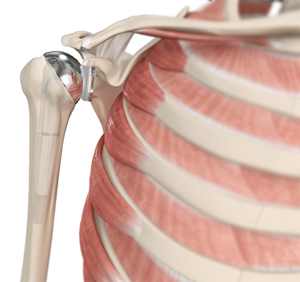
What is Shoulder Joint Replacement?
Shoulder joint replacement, also known as shoulder arthroplasty, is a surgical procedure in which the damaged parts of the shoulder joint are removed and replaced with artificial components made of metal or plastic (prosthesis).
Shoulder Anatomy
The shoulder is a highly movable body joint that allows various movements of the arm. It is a ball and socket joint, where the head of the humerus (upper arm bone) articulates with the socket of the scapula (shoulder blade), which is called the glenoid. The two articulating surfaces of the bones are covered with cartilage, which prevents friction between the moving bones. The cartilage is lubricated by synovial fluid. Tendons and ligaments around the shoulder joint provide strength and stability to the joint.
Types of Shoulder Joint Replacement
- Total Shoulder Replacement: This procedure involves replacing both the humeral head (ball) and the glenoid (socket) with artificial components. Commonly performed for osteoarthritis, rheumatoid arthritis, and severe fractures.
- Hemiarthroplasty: In this only the humeral head is replaced with a prosthesis, while the glenoid is left intact. Commonly performed for fractures of the humeral head or less severe arthritis confined to the humeral head.
- Reverse Total Shoulder Replacement: In this procedure, the positions of the ball and socket are reversed; a metal ball is attached to the glenoid, and a plastic socket is attached to the humeral head. Primarily used for rotator cuff tear arthropathy, severe rotator cuff injuries, and certain complex fractures.
Indications for Shoulder Joint Replacement
Shoulder joint replacement is typically recommended for patients with severe shoulder arthritis, significant joint damage, or other debilitating shoulder conditions that have not responded to conservative treatments.
Preparation for Shoulder Joint Replacement
In general, preparation for shoulder arthroscopy may include the following:
- A comprehensive medical evaluation will be conducted. This may include a review of your medical history, physical examination, blood tests, and imaging studies for detailed evaluation of structures of the shoulder joint.
- You should inform your doctor about any pre-existing medical conditions, allergies, medications, or supplements you are taking.
- Some medications, such as blood thinners, may need to be adjusted or temporarily stopped before the surgery to minimise the risk of bleeding.
- You should refrain from eating or drinking for a specified period before the surgery.
- You should arrange for someone to drive you home after the procedure
- You will be signing an informed consent form
Procedure for Shoulder Joint Replacement
In general, procedure for shoulder joint replacement will involve the following steps:
- The patient is typically placed under general anaesthesia.
- The shoulder is thoroughly sterilised, and the patient is positioned to allow optimal access to the joint.
- An incision is made over the shoulder to expose the joint.
- The damaged portions of the humeral head and glenoid are removed.
- The artificial components (metal ball and plastic socket) are inserted and secured.
- The incision is closed with sutures or staples, and a sterile dressing is applied.
Postoperative Care and Rehabilitation for Shoulder Joint Replacement
- The shoulder is typically immobilised in a sling for a few weeks to allow for initial healing.
- Medications, including NSAIDs and opioids, are used to manage postoperative pain.
- A structured rehabilitation program is designed to restore range of motion, strength, and function of the shoulder.
- Patients are advised to avoid heavy lifting, pushing, or pulling activities until cleared by their surgeon.
- A periodic follow-up appointment will be scheduled to monitor your progress.
Risks and Complications of Shoulder Joint Replacement
Risks and complications associated with shoulder joint replacement include:
- Infection
- Bleeding
- Nerve injury
- Loosening of implants
- Dislocation
- General anaesthesia risks