
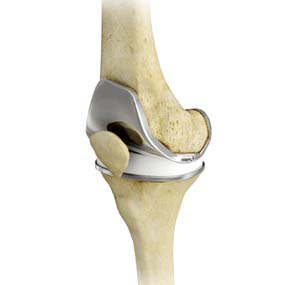
What is Total Knee Replacement?
Total knee replacement, also called total knee arthroplasty, is a surgical procedure in which the worn out or damaged surfaces of the knee joint are removed and replaced with artificial parts. The knee is made up of the femur (thigh bone), the tibia (shin bone), and patella (kneecap). The meniscus, the soft cartilage between the femur and tibia, serves as a cushion and helps absorb shock during motion. Arthritis (inflammation of the joints), injury, or other diseases of the joint can damage this protective layer of cartilage, causing extreme pain and difficulty in performing daily activities. Your doctor may recommend total knee replacement surgery if non-surgical treatment options have failed to relieve the symptoms.
Anatomy of the Knee
The knee is made up of the femur (thighbone), tibia (shinbone) and patella (kneecap). The lower end of the femur meets the upper end of the tibia at the knee joint. A small disk of bone called the patella rests on a groove on the front side of the femoral end. The fibula, another bone of the lower leg, forms a joint with the shinbone. The bones are held together by protective tissues, ligaments, tendons, and muscles. Synovial fluid within the joint aids in the smooth movement of the bones over one another. The meniscus, a soft crescent-shaped area of cartilage between the femur and tibia, serves as a cushion and helps absorb shock during motion.
What are the Indications for a Total Knee Replacement?
Total knee replacement surgery is commonly indicated for severe osteoarthritis of the knee. Osteoarthritis is the most common form of knee arthritis in which the joint cartilage gradually wears away. It often affects older people.
In a normal joint, articular cartilage allows for smooth movement within the joint, whereas in an arthritic knee the cartilage itself becomes thinner or completely absent. In addition, the bones become thicker around the edges of the joint and may form bony “spurs”. All of these factors can cause pain and restricted range of motion in the joint.
Your doctor may advise total knee replacement if you have:
- Severe knee pain which limits your daily activities (such as walking, getting up from a chair or climbing stairs).
- Moderate to severe pain that occurs during rest or awakens you at night.
- Chronic knee inflammation and swelling that is not relieved with rest or medications
- Failure to obtain pain relief from medications, injections, physical therapy, or other conservative treatments.
- A bow- legged knee deformity
What is the Procedure for Total Knee Replacement?
The goal of total knee replacement surgery is to relieve pain and restore the alignment and function of your knee.
The surgery is performed under spinal or general anaesthesia. Your surgeon will make an incision in the skin over the affected knee to expose the knee joint. Then, the damaged portions of the femur bone are cut at appropriate angles using specialised jigs. The femoral component is attached to the end of the femur with or without bone cement.
Your surgeon then cuts or shaves the damaged area of the tibia (shinbone) and the cartilage. This removes the deformed part of the bone and any bony growths, as well as creates a smooth surface on which the implants can be attached. Next, the tibial component is secured to the end of the bone with bone cement or screws.
Your surgeon will place a plastic piece called an articular surface between the implants to provide a smooth gliding surface for movement. This plastic insert will support the body’s weight and allow the femur to move over the tibia like the original meniscus cartilage.
The femur and the tibia with the new components are then put together to form the new knee joint.
To make sure the patella (kneecap) glides smoothly over the new artificial knee, its rear surface is also prepared to receive a plastic component.
With all the new components in place, the knee joint is tested through its range of motion. The entire joint is then irrigated and cleaned with a sterile solution. The incision is carefully closed; drains are inserted and a sterile dressing is placed over the incision.
What Does Postoperative Care and Recovery for Total Knee Replacement Involve?
In general, postoperative care instructions and recovery after primary knee replacement may involve the following steps:
- You may notice pain, swelling, and discomfort in the knee area. Pain and anti-inflammatory medications are provided as needed.
- Antibiotics are also prescribed to address the risk of surgery-related infection.
- You are advised to keep your leg elevated while resting to prevent swelling and pain.
- You will be given assistive devices such as crutches with instructions on restricted weight-bearing for a specified period of time. You are encouraged to walk with assistance as frequently as possible to prevent blood clots.
- Instructions on surgical site care and bathing will be provided to keep the wound clean and dry.
- Eating a healthy diet rich in vitamin D is strongly advised to promote healing and a faster recovery.
- Refrain from strenuous activities for the first few months and lifting heavy weights for at least 6 months. A gradual increase in activities over a period of time is recommended.
- An individualised physical therapy protocol will be designed to help strengthen knee muscles and optimise knee function.
- You should be able to resume your normal activities in a couple of months, but with certain activity restrictions. Returning to sports or high-intensity activities may take at least 6 months or longer.
- Refrain from driving until you are fully fit and receive your doctor’s consent.
- A periodic follow-up appointment will be scheduled to monitor your progress.
What are the Risks and Complications of Total Knee Replacement?
As with any major surgery, the possible risks and complications associated with total knee replacement surgery include:
- Knee stiffness
- Infection
- Blood clots (deep vein thrombosis)
- Nerve and blood vessel damage
- Ligament injuries
- Patella (kneecap) dislocation
- Plastic liner wearing out
- Loosening of the implant
Prognosis
Total knee replacement is an effective surgical option for patients with severe knee arthritis or other debilitating knee conditions. The procedure aims to relieve pain, restore function, and improve the quality of life. Early diagnosis, appropriate surgical technique, and diligent postoperative rehabilitation are essential for successful outcomes and long-term knee health.